
Broken Your Back? What You Need to Know!
Have you suffered a back injury and aren’t sure what to do next? At Optimum Derby, we regularly work with patients who have experienced spinal trauma — from minor fractures to more complex injuries — helping them recover safely and return to the activities they love.
Following a recent consultation with a client recovering from a fractured spine, we’ve put together this blog to help you better understand the anatomy of the spine, common mechanisms of injury, and how we approach recovery and sports injury rehabilitation in Derby.
Anatomy of the Spine: A Quick Overview
The human spine consists of 26 vertebrae, categorised into five regions:
Cervical spine (7 vertebrae): Located in the neck and designed for mobility. These vertebrae support the head, which can weigh 5–8% of your body weight, but do not bear heavy loads.
Thoracic spine (12 vertebrae): Found in the mid-back, it provides attachment points for ribs and muscles. While it allows some motion, its primary role is protection of vital organs.
Lumbar spine (5 vertebrae): Located in the lower back, these vertebrae are much larger and denser, built for load-bearing and stability.
Sacrum and coccyx (2 fused sections): These form the base of the spine, commonly known as the tailbone.
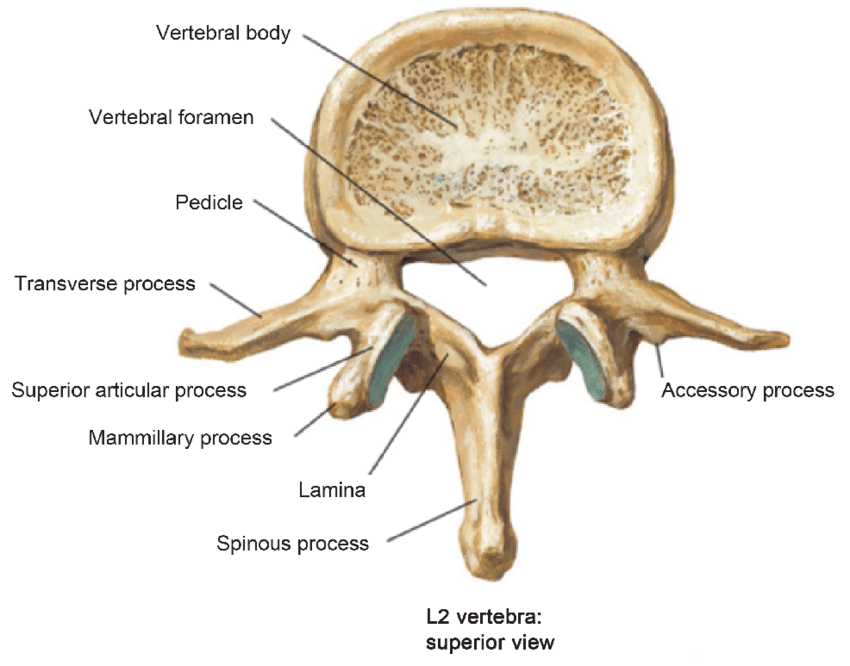
Each vertebra has a vertebral body, transverse processes, spinous process, and vertebral foramen. The lumbar vertebrae, in particular, take on a significant portion of the body’s weight and are often subject to compressive forces, especially during high-impact activities.
Common Lumbar Spine Fractures
Injuries to the lower back can occur during sports, accidents, or heavy lifting. The most frequent types of spinal fractures include:
Compression fractures: Often involving the vertebral body, these are typically caused by excessive axial loading. In more severe cases, these may become burst or wedge fractures.
Spinous process fractures: Typically caused by hyperextension, where the back is forced backwards, causing the spinous processes to pinch and break.
Transverse process fractures: Usually the result of direct trauma or severe muscle contraction.
Anatomical view of a typical lumbar vertebra, highlighting key structures affected in spinal fractures.
What To Do If You’ve Broken Your Back
If you suspect or have confirmed a spinal fracture, seek immediate medical assessment. Once stabilised and cleared for rehabilitation, your recovery plan should be individualised and progressive.
At Optimum Derby, we provide expert physiotherapy for back injuries, supported by:
A thorough biomechanical assessment
Sports-specific rehabilitation planning
Strength and mobility restoration
Gradual return to training and competition
One of our clients recently sustained a spinous process fracture. After early intervention and targeted rehabilitation, he was back in the gym within five days, completely symptom-free, and actively discussing his long-term goals for sport.
Our Approach to Back Pain and Spinal Injury Rehab
We take a comprehensive and evidence-based approach to back injury treatment in Derby. Whether you’re recovering from a spinal fracture or dealing with chronic back pain, our sports physiotherapy and injury rehabilitation services will guide you safely through each phase of recovery.
We combine manual therapy, progressive loading, strength conditioning, and where needed, remote programming to help you achieve optimal results.
Need Help With Back Pain or a Spinal Injury?
If you’re unsure about your diagnosis, are suffering from lingering back pain, or want to return to sport safely after a lumbar injury, we can help.
📍 Visit Optimum Derby – Sports Injury and Physiotherapy Clinic in Derby
📞 Contact us today to book a consultation and start your personalised rehabilitation plan.